Hello There.
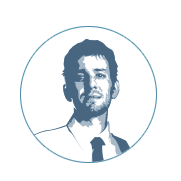
My name is Jon Weiss. I work as a commercial artist, specializing in motion graphic animation. Operating in the space between traditional 2D animation and visual effects, I work with original illustration, photography, footage, typography, and digitally-generated elements to create mixed-media animation.
My practice spans the entire production cycle of animated work, from pre-production conceptualization, writing, and design, through production illustration and animation, and right through post. This multi-disciplinary approach is fun for me, giving me lots of variety in my work and offering the satisfying capability to craft a whole project from beginning to end. It also provides exceptional flexibility and efficiency for my clients. I pair these creative skills with a technical skillset that spans a wide range of image creation, digital compositing, and postproduction visual effects techniques. This allows me a broad stylistic range, the ability to move seamlessly across a diverse mixture of media, and a unique aptitude at solving complex problems, whether they are conceptual or technical in nature.
My work is sometimes overlaid on footage, adding another narrative dimension to what was captured in-camera. It also often stands alone or gets interspersed with footage in an edit, which comes in very handy when a filmmaker needs to tell a story visually and does not have the option of using footage to do it, or has to unspool an complex or abstract idea in an intuitive way that viewers can immediate grab a hold of.
Curriculum Vitae
I bring 25 years of commercial experience, robust formal training, a knack for narrative & a strong graphic design sensibility to my work.
My design career started in New York City in 1999, and I have been full-time freelance since 2003. I started working with print and web, but my practice has been focused on video since 2007. I transitioned from Flash to Adobe After Effects on version 6.0, and AE has been my trusty steed ever since, through 19 versions of the software…and counting! Suffice it to say, I’ve got that saddle nicely broken in.
I hold a Masters degree in Fine Art from the Design+Technology program at Parsons, where I studied narrative media with a focus on motion graphics, and a BA from the Gallatin School at New York University. You can check out more details of my resume on LinkedIn.
Today I live and work in Pawlet, Vermont. When not at my desk, I am very active with our community volunteer fire department. I have served as Fire Chief since 2017. In addition to my work as a firefighter, I am also a passionate educator. My “side gig” is helping other firefighters learn our trade for the Vermont Fire Academy, where I have worked since 2016 and am currently a lead instructor.
So, uh… what the heck is a Surfacist?
Surfacism is a made-up term that started as a joke in my MFA thesis studio at Parsons, but took on a life of its own, and has come to both describe and inform my practice. As a 2D animator I make composite work, layering flat pieces of media atop one another. I am a specialist in working with planes: surfaces. But in a more figurative sense, I see video itself as a surface. When someone watches a time-based work on screen, she might find it to be compelling or boring, graceful or awkward, beautiful or ugly. What is being judged isn’t just one character design, or one color choice, or one transition, it is the piece as a coherent whole. You can’t shift your angle, or run your hands over it, or pick up one small piece and hold it up to the light. Video is peculiar in this way. It goes together like a building, piece by piece, layer by layer. But when finished, it’s not like a building, it’s much more like the reflection of a building in a still pond: a surface.
This is the idea I like to keep in mind as I approach my work.
Position on AI
I work at the intersection of several fields that are rapidly being automated by AI technologies. I believe it important to be clear with clients about what role these technologies play in my work. As a commercial artist whose practice has always been technologically-facilitated, I have spent my career on the lookout for labor-saving tools I can adopt to offer better value to my clients, and less tedium for myself. I make extensive use of motion tracking, edge detection, edit detection, image tracing, and other software processing tools in my work. Software vendors have lately taken to calling these tools “AI” for marketing purposes, but that’s quite a stretch, as they are not trained on an external dataset or processed remotely.
Generative AI tools (ChatGPT, Gemini, Grok, etc) are something very different. These tools don’t just automate, they automatically outsource, and do so exploitatively, at that– they bring to bear the work of other humans who did not consent and were not compensated. I know because my own work has been used to train AI models, without my consent and without compensation. Generative AI creates media that is unintentional and is not entirely under the control of the artist to manipulate as they, or their client, sees fit. That intentionality and control is what my work is all about.
There are fantastic things people are doing with AI tools, including using AI tools as parts of creative processes. But the wholesale automation of creative work using generative AI is awful. These tools mimic the output of human workers, but with neither the humans, nor the work. Stripped of humanity and labor, creative work is not just valueless, but also pointless. The magic of a song that moves you, for example, is that you share a human connection with the musician: she saw something in the world you both inhabit, and used her creative skill to depict it, and that depiction can resonate powerfully with you. Who wants to listen to a song conveying emotions no human ever felt? Perhaps more importantly, who would choose to live in a world that neither values nor supports musicians? I believe it is intrinsically valuable to have humans engaged in creating original work and documenting our shared human experience, even in a commercial context.
TLDR: Generative AI has no place in my practice. If you pay me, you are paying for a human to do thoughtful, intentional work on your behalf.